July 1, 2026 · 8:27 AM
The Olympics swallowed by a fair
On July 1, 1904, the first Olympics held outside Europe opened in St. Louis as a World’s Fair sideshow, producing one of the strangest Games in sports history.

On July 1, 1904, the St. Louis Summer Olympics opened as the first modern Olympic Games held outside Europe and the first held in the United States. 1 2 That sounds like a clean milestone. The weird part is that the Olympics were barely the main event.
The Games were folded into the Louisiana Purchase Exposition, the St. Louis World's Fair, and the fair's organizers treated them as one more attraction on a giant midway. 3 4 The result was a 146-day Olympic sprawl that ran from July 1 to November 23, with athletic events scattered through the fair calendar instead of concentrated into anything resembling a modern Games. 1 4
Even the date has a little mess baked in. Most broad references place the 1904 Olympics from July 1 to November 23, while Olympedia also records an opening ceremony on May 14 during the fair season. 1 4 That disagreement is almost the perfect introduction to St. Louis 1904: the Olympics were so tangled with the World's Fair that later historians have had to sort out what counted as Olympic sport and what was just fairground sport wearing an Olympic label. 3
Chicago won it. St. Louis got it.
The oddity began before the opening day. Chicago had originally won the right to host the 1904 Olympics, but St. Louis was preparing the Louisiana Purchase Exposition for the same year and did not want a rival international sports festival 297 miles away. 5 The International Olympic Committee moved the Games to St. Louis after a 14-2 postal vote in December 1902, and Pierre de Coubertin notified Chicago by telegram on February 10, 1903. 1 5
Jody Sowell of the Missouri History Museum later put the theft theory in the bluntest possible way: "St. Louis did steal the Olympics from Chicago." 5 Coubertin, the French founder of the modern Olympic movement, did not attend the St. Louis Games; History.com quotes his memoir line that he had "a sort of presentiment that the Olympiad would match the mediocrity of the town." 3
The field was almost America versus America
The St. Louis Olympics drew only about 10 to 13 participating nations, depending on how disputed national affiliations are counted. 1 4 About 648 to 651 athletes competed, and more than 80 percent of them were Americans. 1 4
That lopsided field gave the medal table a house-league feel. The United States won roughly 248 medals, including about 80 golds, while Germany finished a distant second with 14 medals. 1 4 Sharon Smith of the Missouri History Museum summed up the competitive imbalance this way: "America was against America. It wasn't the U.S. against someone else." 6
The fairground setting made the bookkeeping worse. Organizers slapped the Olympic label on a broad run of sports programming, and History.com notes that some historians still have trouble separating official Olympic contests from other athletic exhibitions at the fair. 3 If a trivia night asks which Olympics included a haze of fairground side events, St. Louis is the answer that comes with an asterisk.
The marathon became the punchline
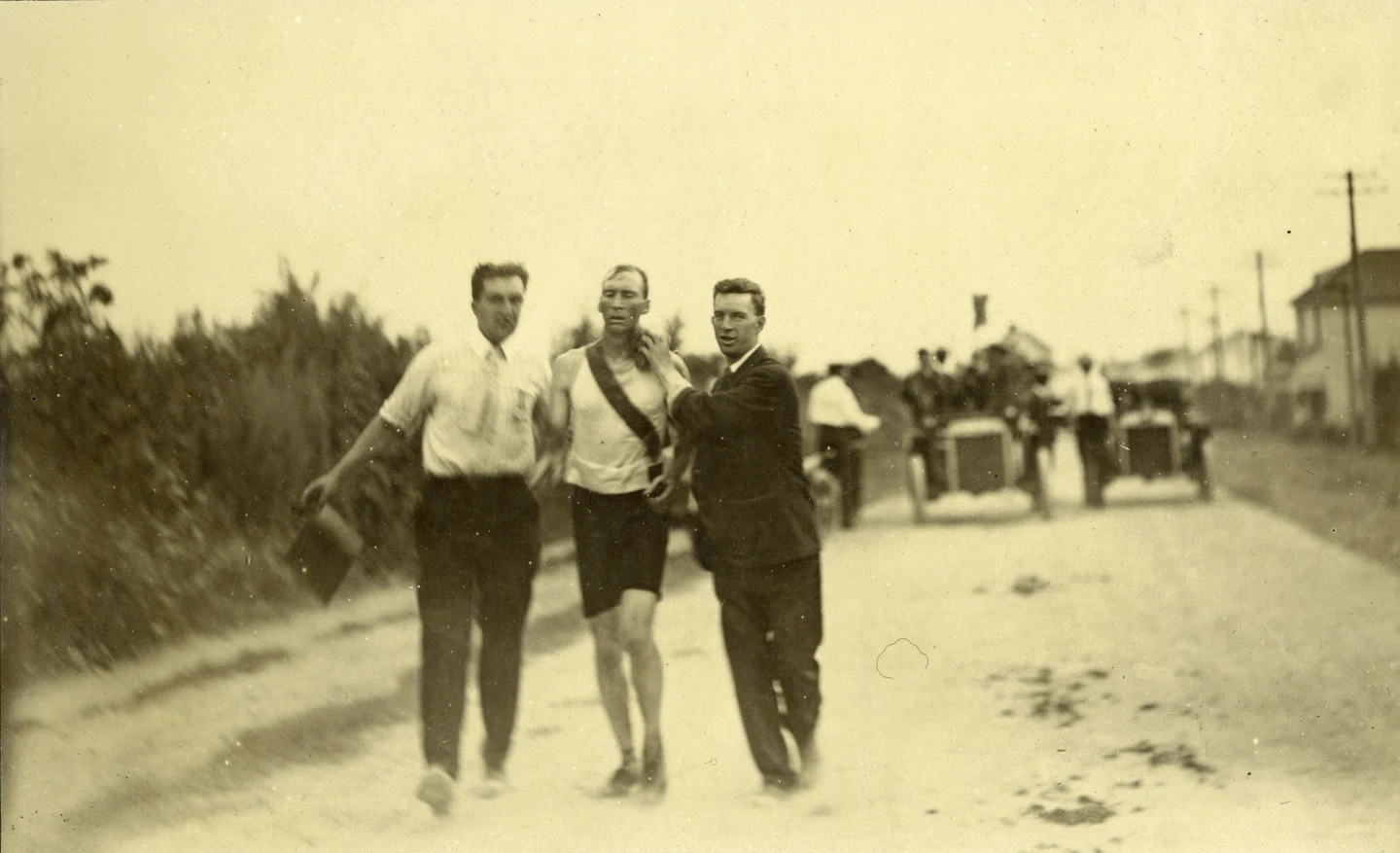
The Games' most famous disaster did not happen on July 1, but it explains why this opening date belongs in the oddity file. On August 30, 1904, 32 runners started the Olympic marathon in about 90°F heat on dusty roads, and only 14 finished. 7 8 The course was about 24.85 miles, shorter than today's standardized 26.2-mile marathon distance. 7
Fred Lorz stopped after about nine miles, rode roughly 11 miles in a car, then re-entered the course and crossed the line first before officials exposed the ride. 7 8 Thomas Hicks, the actual winner, was kept going with strychnine, egg whites, and brandy, then finished in 3:28:53, a time widely cited as the slowest Olympic marathon victory. 7 8 Hicks later said, "Never in my life have I run such a tough course. The terrific hills simply tear a man to pieces." 7
Félix Carvajal of Cuba reached St. Louis after losing his money in New Orleans, raced in street clothes that were cut down at the legs, stopped to chat with spectators, ate fruit during the race, and still finished fourth. 7 Len Tau and Jan Mashiani of South Africa became the first Black Africans known to compete in the modern Olympics, and Tau reportedly lost time after being chased off course by dogs. 7 8
The fair's ugliest experiment sat beside the sport
St. Louis 1904 was bizarre, but some of its weirdness was cruel rather than funny. On August 12 and 13, fair organizers staged Anthropology Days, a racist exhibition in which Indigenous and colonized people from the fair's ethnological displays were recruited to compete in athletic events before thousands of spectators. 9 4 The events included standard athletic contests such as sprinting, shot put, long jump, javelin, archery, and weightlifting, along with staged events such as mud fighting and pole climbing. 9
James Sullivan, one of the organizers, drew an openly racist conclusion from the spectacle, writing that "the savage has been a very much overrated man from an athletic point of view." 9 Coubertin later called Anthropology Days an "outrageous charade," and Olympedia records his prediction that it would lose appeal once Black, Indigenous, and Asian athletes learned to run, jump, and throw well enough to leave white athletes behind. 4
The strangest part: it still changed the Olympics
For all the chaos, the 1904 Games also introduced the now-familiar gold, silver, and bronze medal system for first, second, and third place. 1 Boxing appeared on the Olympic program for the first time, freestyle wrestling made its Olympic debut, and George Poage became the first African American Olympic medalist when he won bronze in the 200-meter and 400-meter hurdles. 1 5
George Eyser, an American gymnast with a wooden left leg, won six medals in St. Louis: three gold, two silver, and one bronze. 1 Ray Ewry, who had been affected by polio as a child, won three standing-jump gold medals at the same Games. 1 Those achievements make St. Louis harder to dismiss as pure farce.
That is the shareable July 1 fact: the first Olympics outside Europe opened in St. Louis as a World's Fair sideshow, after being moved from Chicago, with an overwhelmingly American field, a muddled event ledger, and a marathon so strange that a car ride, strychnine, and a roadside nap all belong in the same recap. 1 3 7
Cover image: Thomas Hicks being helped during the 1904 Olympic marathon, via Smithsonian Magazine.
References
- 1Wikipedia: 1904 Summer Olympics
- 2Britannica: St. Louis 1904 Olympic Games
- 3History.com: 8 Unusual Facts About the 1904 St. Louis Olympics
- 4Olympedia: 1904 Summer Olympics Overview
- 5KSDK: Did St. Louis steal the 1904 Olympics from Chicago?
- 6St. Louis Public Radio: In 1904, St. Louis hosted the first Olympics on American soil
- 7Smithsonian Magazine: How the 1904 Marathon Became One of the Weirdest Olympic Events of All Time
- 8Olympics.com: The strange case of the St Louis 1904 marathon
- 9Smithsonian NMAI Magazine: The Sideshow Olympics
Add more perspectives or context around this Post.