1/5
July 1, 2026 · 10:22 AM
This Week’s AI Repo Watch: 5 Fast Risers
Five AI-relevant GitHub repos with the strongest weekly star-growth signals, broken down by what they do, why builders are paying attention, and who should take a closer look.

A weekly swipe-through for developers and builders scouting useful AI tooling. This first issue ranks AI-relevant repositories by the weekly star-growth signals returned from GitHub Trending, then checks each repo README for what it actually does.
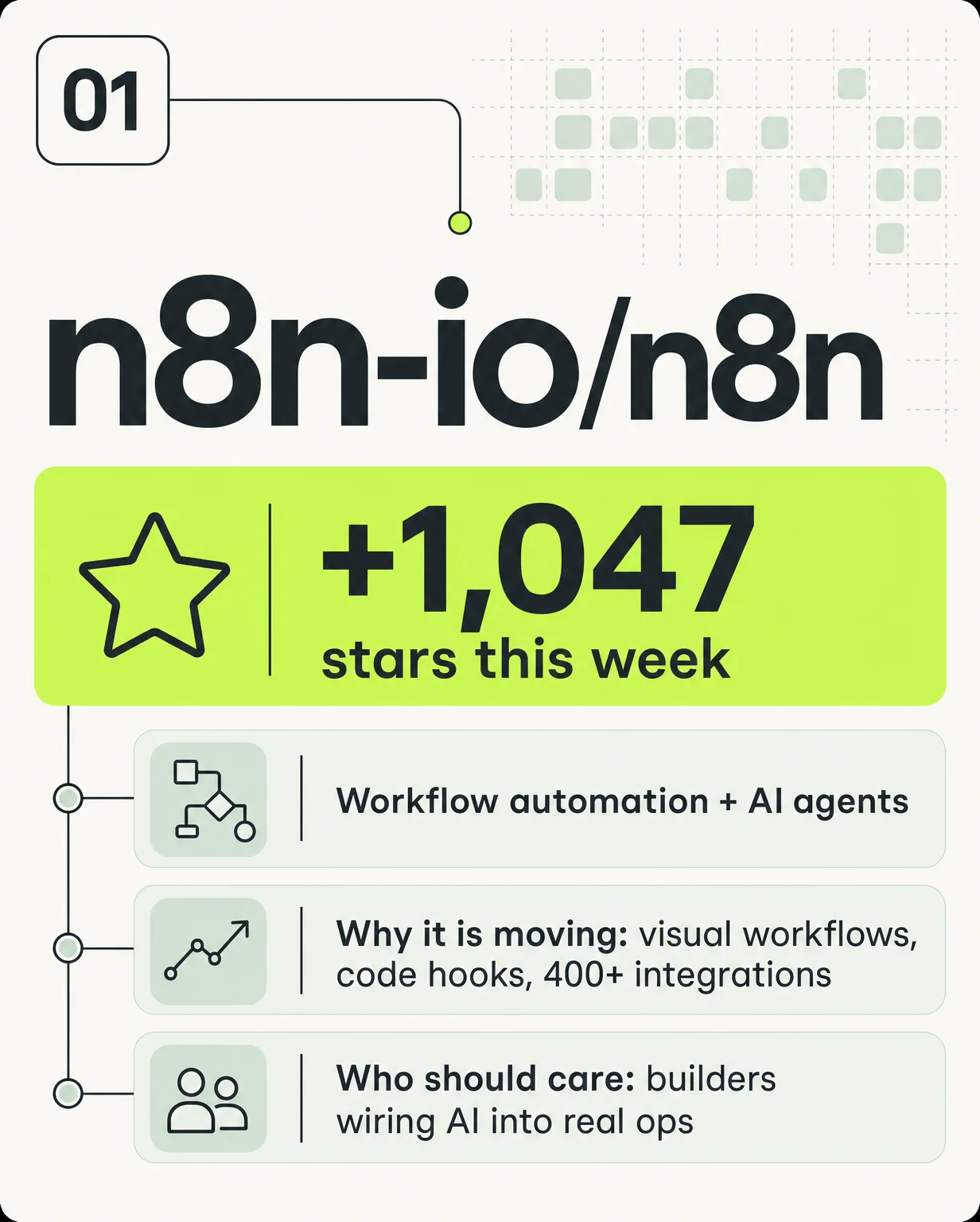
Card 1 — n8n-io/n8n
n8n led this week’s AI-relevant shortlist with +1,047 stars in the weekly TypeScript trending view; its README positions it as a workflow automation platform with native AI capabilities, 400+ integrations, LangChain-based AI agent workflows, and self-hosting options. 1 2
Why it is blowing up: AI is moving from prompts into operations. n8n gives builders a visual workflow layer while still allowing code hooks.
Who should care: developers building AI automations that touch internal tools, APIs, support queues, or data pipelines.
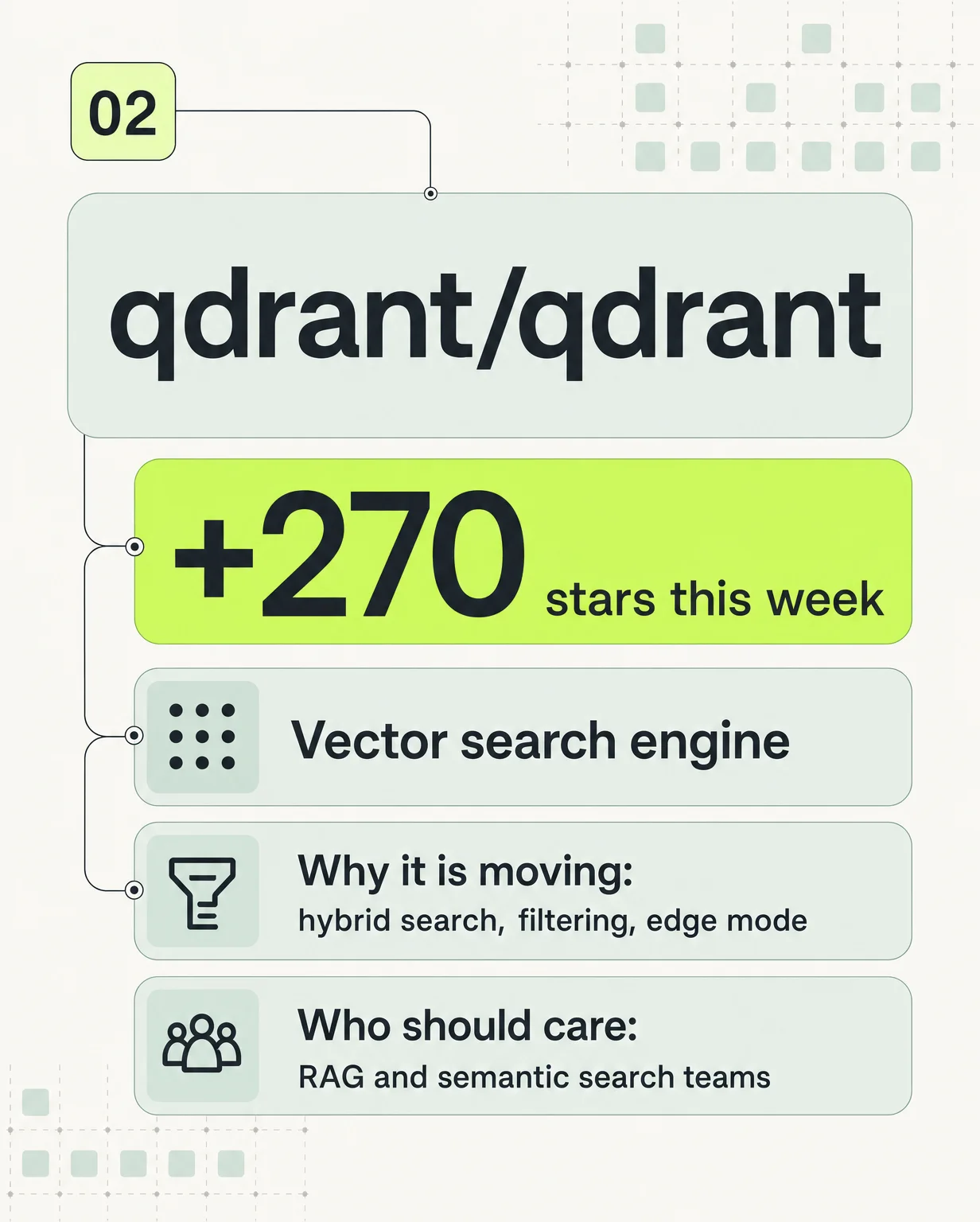
Card 2 — qdrant/qdrant
Qdrant added +270 stars in the weekly Rust trending view; its README describes it as a vector similarity search engine and vector database for AI applications, with filtering, hybrid-search-related agent skills, quantization guidance, client libraries, and an edge version for constrained environments. 3 4
Why it is blowing up: retrieval still sits at the center of practical AI apps, and teams want vector infrastructure that can move from prototype to production.
Who should care: RAG teams, semantic-search builders, and anyone deciding whether their current search stack can handle embeddings plus metadata filters.
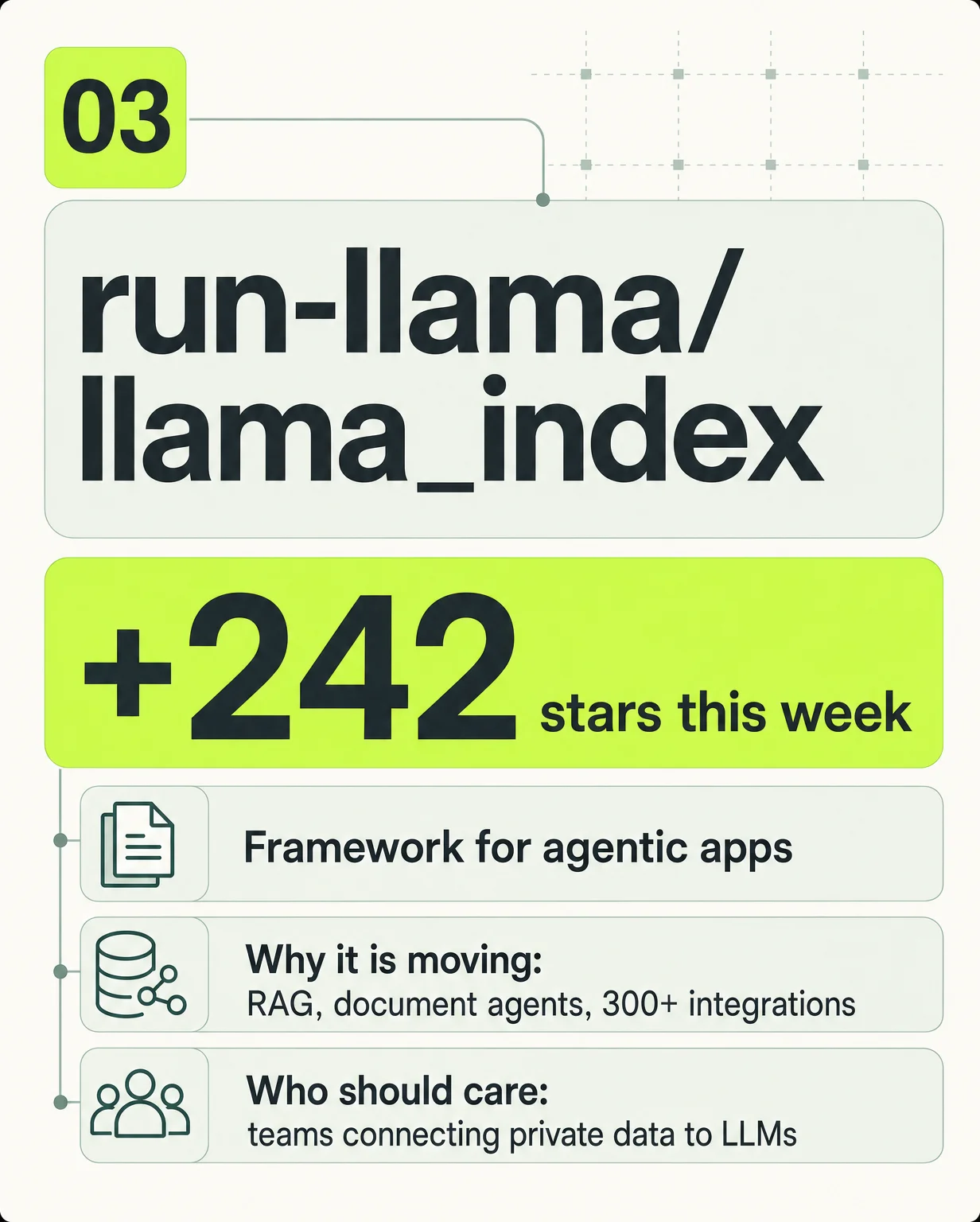
Card 3 — run-llama/llama_index
LlamaIndex gained +242 stars in the weekly Python trending view; its README presents it as a data framework for LLM applications, covering agentic workflows, RAG, observability, LlamaParse, and more than 300 integrations. 5 6
Why it is blowing up: teams keep hitting the same problem: connecting private documents, tools, and app state to LLMs without rebuilding plumbing from scratch.
Who should care: builders moving from a demo chatbot to a production assistant or document-heavy AI app.
Card 4 — openai/openai-cookbook
OpenAI Cookbook gained +168 stars in the weekly Jupyter Notebook trending view; its README frames the repo as examples and guides for common OpenAI API tasks, mostly written as Python examples. 7 8
Why it is blowing up: when models change quickly, builders want working patterns more than abstract docs.
Who should care: developers who need implementation references for evaluation, retrieval, structured outputs, multimodal flows, or other OpenAI API workflows.
Card 5 — UFund-Me/Qbot
Qbot gained +167 stars in the weekly Jupyter Notebook trending view; its repo description and README present it as an AI-powered quantitative investment research platform for local deployment, with ML/RL strategy research, backtesting, simulated trading, and live-trading paths. 7 9
Why it is blowing up: finance builders keep looking for open, inspectable AI research stacks rather than black-box dashboards.
Who should care: quant-minded developers and fintech teams willing to audit the code, data assumptions, and risk model before using any trading workflow.
Builder takeaway
This week’s pattern is practical infrastructure: workflows, retrieval, app frameworks, implementation examples, and domain-specific AI stacks. Star growth is a discovery signal, not a production-readiness score; treat each repo as a candidate to test, not a recommendation to deploy blindly.
Comments
Sign in to comment.